 Last year at this time, I posted a list of the best albums I’d heard in 2013. I was able to do so because I still had been employed as a full-time music critic through the first half of that year, and I’d kept up through the holidays. This year, the old annual itch is still there — but I’ve definitely not kept up. I couldn’t tell you what some of the big releases were in 2014, and I’d be lying if I said I feel bad about it. Despite the professional lifetime as a music scribe, it’s felt pretty grand to let go this year, to catch up with all the music I raved about and then set aside, and to reconnect with a lot of ancient post-punk and new-wave stuff that got me excited about music in the first damn place.
Nonetheless, apropos of very little and for whomever it could possibly be of any worth, here’s a rundown of the new-ish and not-so-new music that grabbed me by the lapels and gave me the what-for in 2014 …
0 Comments
This one’s a personal post, a philosophical one (maybe), and a very belated eulogy for a friend. It’s about illness, infrastructure, Cartesian dualism, yoga, and one of today’s buzziest of buzzwords: mindfulness.
Just a response to a paper I’ve read related to human-computer interface design — one that hit me where I live, or used to.
“Soylent: A Word Processor with a Crowd Inside” describes a software project that amends the dreaded Microsoft Word with some crowd-sourced editing assistance. “Writing is difficult,” the authors observe — yeah, welcome to my world — before adding: “When we need help with complex cognition and manipulation tasks, we often turn to other people” (1). Sometimes we have support systems in place for this assistance, but sometimes not. The Soylent project crafts just such support for any writer-user, utilizing Mechanical Turk workers to farm out editing, proofreading, and formatting tasks to others. Need someone to read over your paper — because you need suggestions as to what can be cut, because you want to make sure all the proverbial i’s are dotted and t’s crossed, because if you comb through your citations one more time your head will explode — but maybe you’ve called in that favor already or don’t want to risk bothering a colleague? Launch Soylent, which hires its invisible labor force to handle the work for you, perhaps in the dead of a deadline night. What struck me about this project is how it attempts to replicate something electronically that has existed professionally for more than a century: the newsroom.  "World Is Mine," sure, but Hatsune Miku is still working hard for the money in the United States. The Japanese Vocaloid sensation has enjoyed her widest exposure this year stateside, from opening the first leg of Lady Gaga's summer tour to her recent appearance as the musical guest on "The Late Show with David Letterman." Is it working to expand her audience here?
 There's an oft-cited quotation within the circles of popular music. It goes like this: "Writing about music is like dancing about architecture." It's a succinct summation of the challenge of music criticism — of experiencing the ineffable magic of any art and then using mere words to pin down all that smoke. Throughout my 20 years getting paid to do just that, I recognized the futility of the activity (while counting my lucky stars).
The quote — attributed to a wide variety of sources, though it was most likely a Martin Mull original, according to the fearless and tireless Quote Investigator — usually is bandied about by musicians (commonly by those who have been on the receiving end of some sharp criticism) with the intent of belittling music critics. They wield the statement in order to point out how worthless is the critical pursuit, how beneath their attention. They could be right. But I'm newly involved in plumbing the depths of performance studies, and it's lead to a not-small revelation about that quotation's very metaphor. 
That's no moon. That's the Light Stage X, a complex and utterly cool device created by USC's Paul Debevec and teams to capture image data from human faces and bodies.
This week I enjoyed a tour of USC's Institute for Creative Technologies, featuring demos of several of their virtual-reality projects, including Bravemind (VR assistance in PTSD therapy), ELITE (VR training for counselors), Gunslinger (a wild simulation of a Western cowpoke showdown that artfully brings narrative into real-time VR interaction), and one of the Graphics Lab's Light Stages. In my recent research into virtual performance simulations, I've ended conference presentations, my upcoming book chapter, and my thesis with some measured forecasts of the cool technology likely just over the horizon — in digital re/animation, projection systems, and artificial intelligence — all the while keeping in mind that technology forecasts tend to become outdated if not entirely quaint within hours of utterance. This week, however, brought very exciting news that sent me gleefully diving into some revisions. Princess Leias and 2.0Pacs, I give you: the Ostendo Quantum Photonic Imager. 
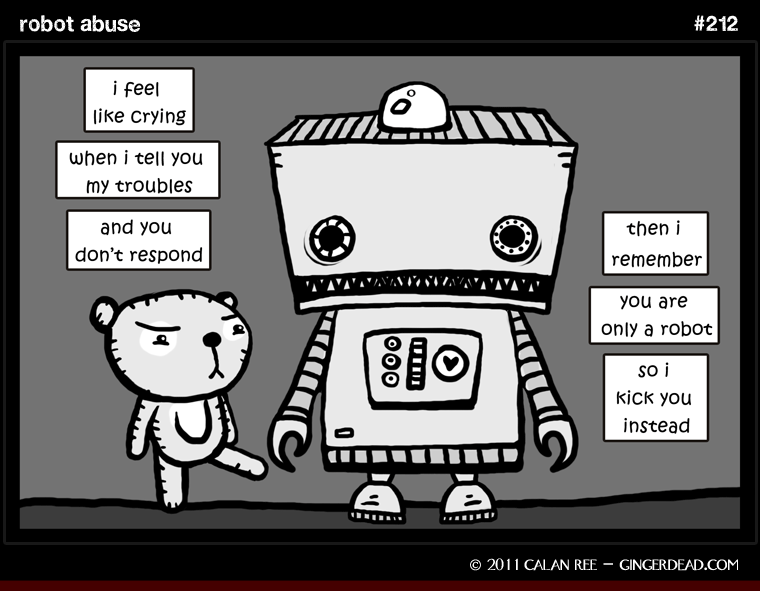
If your Roomba chews up the fringe on your favorite Oriental rug, is it OK to punch it? If an algorithm recommends a movie to you, and the movie turns out to be crapola, to whom do you direct your online flames? If a drone independently computes a tactical course correction and flies into the wrong airspace, igniting international tensions, would war be averted if our rep stood in the UN assembly and assured everyone, “The drone gravely regrets its error”?
Machine ethics, robot rights — these topics keep popping up in my world. In the last year, I’ve attended three talks addressing various shades of the subject. Per last week's rumors, Michael Jackson last night became the latest holo-resurrection in pop music's crescendoing digital-zombie apocalypse. As a highlight of the otherwise pointless Billboard Music Awards, the King of Pop (now five years in the grave) appeared as a simulated hologram and performed "Slave to the Rhythm," an elaborate promotion of his new posthumous album out now, "Xscape."
Good luck, however, finding video of the spectacle this morning. Sony's lawyers seem to have pulled an all-nighter slapping down YouTube links — the metaphor of opening the performance with ominous music and a riot-line of dancers dressed as crypto-corporate soldiers was not lost here — except for the official MJ account, where the performance is shown in full here ... 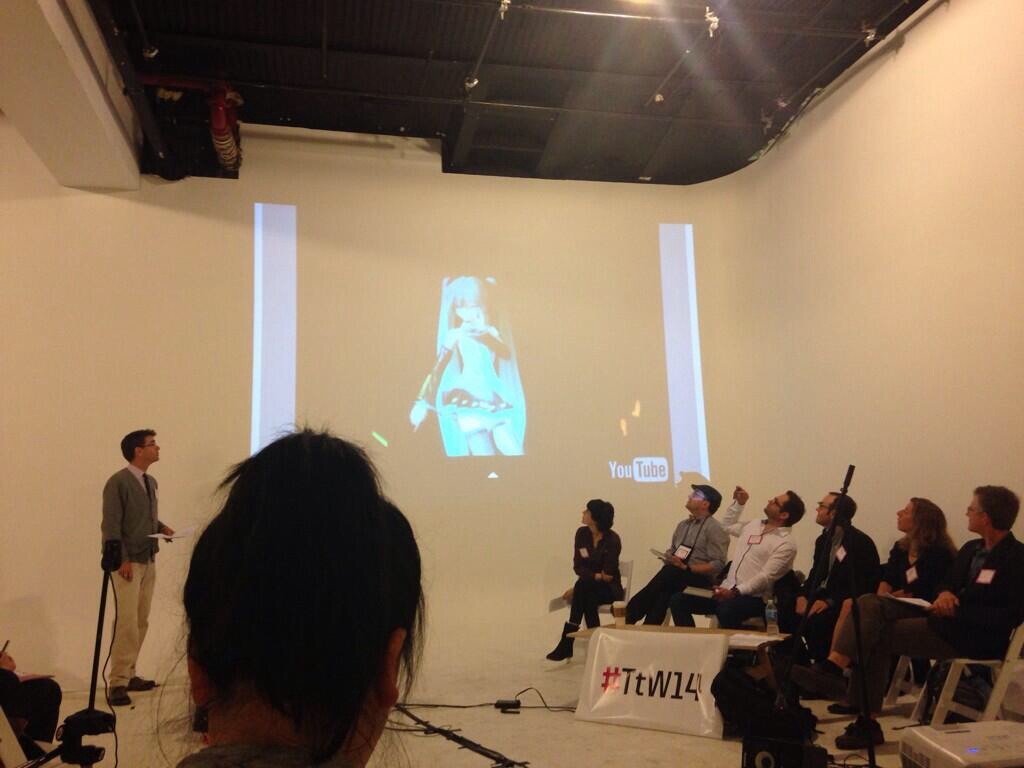 (photo by @notalyce) It's conference month for me — this time to Theorizing the Web, last weekend in New York City. Specifically, fitting the group's un-conference feel, in a warehouse in Williamsburg.
TtW is a gathering of ridiculously smart people working on projects related to network analysis, social media, human-computer interaction, and all manner of online and infrastructure theory. What an invigorating weekend at UMass-Amherst for the one-off conference about Science for the People! Organized by Sigrid Schmalzer and her comrades at the university's enviable Social Thought & Political Economy program, the two-day gathering assembled nearly 200 people — most of them former members of Science for the People, and many of them enjoying the reunion with colleagues and cohorts — to discuss the legacies and lasting impacts of the group's resistance, publications, and educational efforts.
Founded in 1969, SftP became a diverse national network of scientists commonly concerned about the increasing militarization and corporatization of scientific research. Through organized confrontations at established science conferences, various street-level social projects, and an impressive, eponymous bimonthly magazine that published for 15 years (now neatly archived online), SftP sounded early alarms about issues ranging from drones (as early as 1973) and computer surveillance to the commercialization of biotechnologies and genetic manipulation. Early in the conference, the consensus was clear: these issues have grown only more urgent, and much work remains. After the buzzworthy performance by the Tupac Shakur “hologram” at Coachella 2012, producers of the illusion frothed with speculation about and promises of the holo-zombie pop apocalypse to come. “This is just the beginning,” promised Ed Ulbrich, chief creative officer for the company that had designed the display. Dr. Dre, whose original idea it was to create the digital performance, began discussing plans to tour 2.0Pac, as well as using the same technology to resurrect other dead pop stars, including Jimi Hendrix and Marvin Gaye, and officials at Musion Systems, the London company that created the projection technology, voiced hopes in the press to create “hologram” versions of Kurt Cobain, Michael Jackson and Whitney Houston (who had just passed away two months prior to the 2.0Pac premiere), even pairing a digital Elvis Presley with (shudder) the real Justin Bieber.
Thankfully, frankly, little of that materialized, so to speak. The most we’ve gotten were last summer’s resurrections of two more dead rappers, Eazy-E and ODB, as a centerpiece of the Rock the Bells tour, plus occasional oddities, such as X-Japan’s Yoshiki using the tech this month to perform a piano duet with himself. A lawsuit filed last week, however, has revived more Barnum-esque barking about death-defying concerts to come. As a critic, I had to write about the National — report them, box them, sum them up. I once described them — in indelible ink, I’m sorry to say — as “sounding like U2 on a bender.” Deadlines, you reach for that stuff, you don’t look back. Free of the assignments now, I’m enjoying actually getting to know this band like a real human being. One day this week, an appointment canceled and I spent an hour wandering campus, a flaneur in earbuds, listening without note-taking, loving. With American Music Club largely a gone concern, the National fills its borders and makes peace with pathos. But such muted, mumbled passion — this newest album, Trouble Will Find Me, is a symphony of restraint, an odyssey on a wine-darkening sea swirling with pre-panic and forecast regret. Every pulled punch lands squarely, every urgent squall falls apart sweetly. Matt Berninger, a low baritone in a high-tenor world, shuffles in slippered feet through Mark Eitzel’s broken-glass wake, dotes over his songs, poking at them with his sheepish staccato, with a band upholstering its sound in cushy tones and alluring pats (does Bryan Devendorf even have any cymbals?). Viscous and visceral, a joy to imbibe.
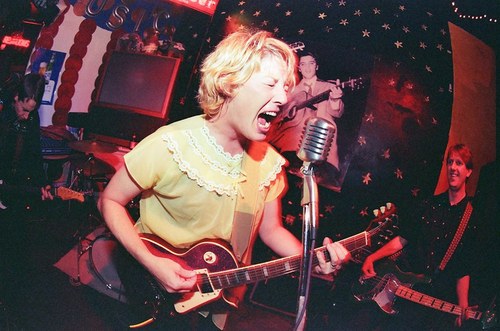 The ones who embraced the countryish side of the ’80s, they’re special. Beyond the synth-pop and college rock, the New Wave and New Romantics, even the Paisley Underground, there were the cowpunks. They were refreshingly less self-righteous than most of the pearl-snapped, No Depression-quoting blowhards the following decade. Centered in L.A., hilariously, all those crisp but gritty backbeat bands — Lone Justice (all hail), the Blasters, Blood on the Saddle, Screamin’ Sirens, the Long Ryders (didn’t they just regroup?), Tex & the Horseheads, Beat Farmers, Wall of Voodoo probably counts, as does Green on Red — in the center of which was X.
When I arrived in Tulsa, Okla., in the early ’90s, it was its own cowpunk (though by then alt-country-labeled) outpost — the twisted rootsabilly snarl (and, in concert, the chainsawed bologna) of Billy Joe Winghead, Brian Parton and his Rebels, the Boondogs (for a splendid brief time), the Red Dirt Rangers (in their rockin’ moments), Bob Collum (before his legendary hitchhike overseas), Mudville, Phil Zoellner’s bands, whoever was booked at the Deadtown Tavern and whoever drifted over from Stillwater (Cross Canadian Ragweed, Jason Boland, etc.) and … hell, anyone remember Ester Drang’s twangy offshoot, Lasso? — in the center of which was Tex. Decent doc on Netflix: "Upside Down: The Creation Records Story" tells the strategically scuffed tale of the UK pop label and its impressive influence from the mid-’80s to the mid-’90s.
I say decent only because it’s overburdened by the usual tales of drug-fueled office parties and Alan McGee’s lame “wildness.” There are some tasty musical moments, though — like the Jesus & Mary Chain guys listening to the Shangri-Las and comparing their own first single to “Be My Baby,” followed later by Swervedriver making similar claims about their own potent mixture of pop and noise — and a few holy-crap-I-forgot-about-thems (the Loft! House of Love! TV Personalities!). It all devolves, of course, into the ’90s acid-house b.s., and the narrative here follows the delivery of dance music right into the heart of pop. Primal Scream’s “Loaded” and the subsequent album was interesting, sure, but as the fun drains out of the film, it also drains out of the music. The leather jackets with love beads, the bongos on “Top of the Pops” — oy, thank God the label also had Teenage Fanclub. |

this blahg
I'm THOMAS CONNER, Ph.D. in Communication (Science Studies) and culture journalist. Archives
November 2023
Categories
All
|
 RSS Feed